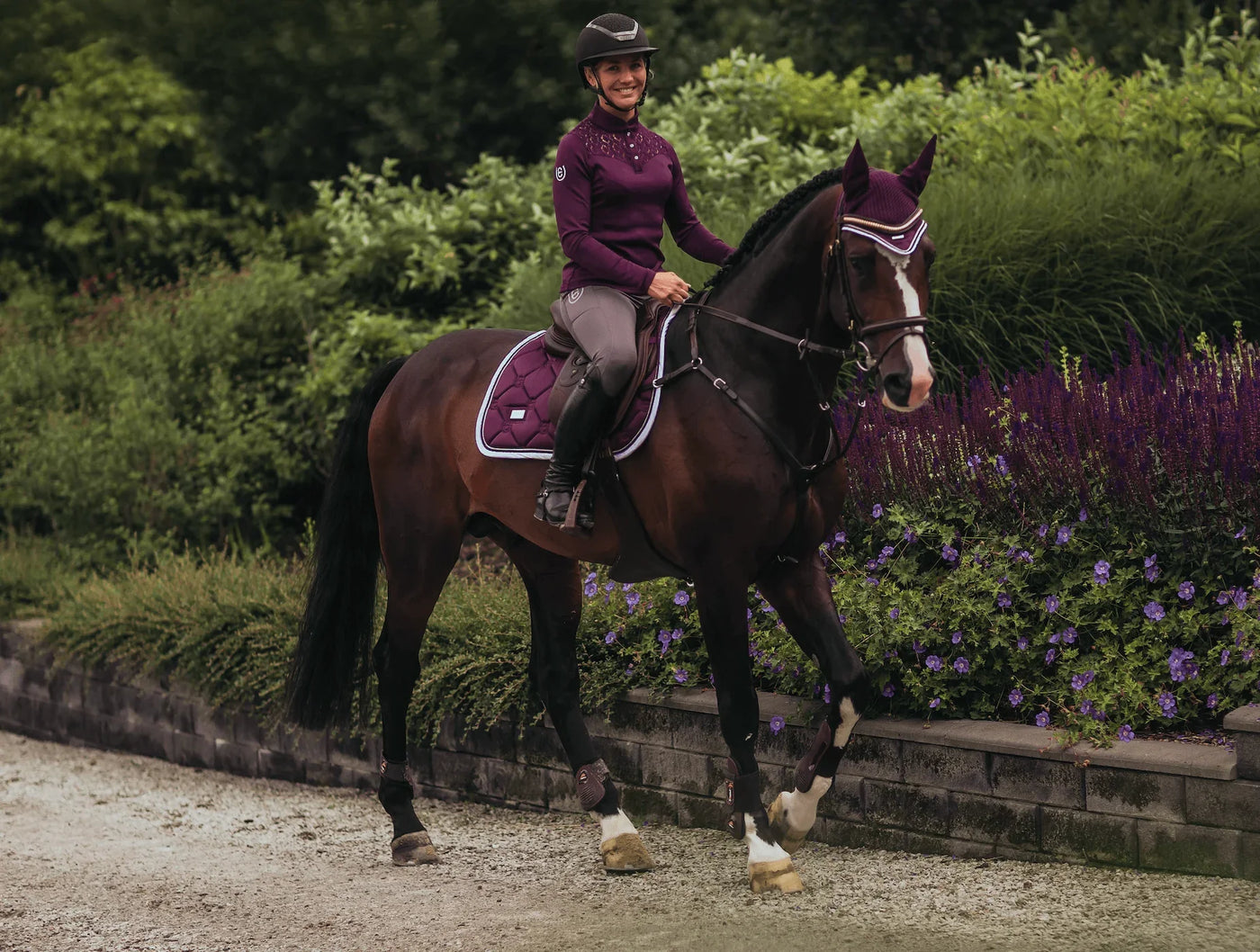
1. The Triangle Reins
The TRIANGLE REINS are among the #BASICS of Training Aids. Due to their simple and quick fastening, triangle reins are among the most popular Training Aids. They provide your horse with a lateral frame while leaving enough freedom for the neck. The horse has the opportunity to reach forward-downward to the bit, preventing it from throwing its head up. But caution: you must ensure your horse does not come too low. Otherwise, it can quickly get behind the Reins, no longer stretch genuinely to the bit, and mainly run on the forehand.
Triangle reins are also very popular for Lungeing and are suitable for rider seat training.
2. The Running Reins
The RUNNING REINS are, alongside triangle reins, a very popular form among beginner riders. They consist of two Reins attached on both sides of your horse between the bit and the Girth. It is important that the running reins lie horizontally when your horse is in correct posture. Your horse is clearly framed, both frontally and laterally, giving you the opportunity to focus on your seat. However, this also means your horse cannot stretch forward-downward but would instead curl up. Running reins can also be found with elastic inserts. However, this can cause your horse to lean on the running reins and no longer carry itself.
3. The Sliding Reins
With the SLIDING REINS, you have several fastening options. On the one hand, you can fasten them under the belly like triangle reins. This is especially suitable for loosening work because your horse has the opportunity to stretch forward-downward to the bit. In this case, the fastening is like that of triangle reins. But this also means you must be careful with sliding reins that your horse does not come behind the vertical when stretching too far toward the ground. The other option is to fasten the two ends laterally. This setting offers your horse very good lateral restriction, and you can work on its uprightness. You can also adjust the degree of uprightness depending on how high the Training Aid is fastened. However, it is important to know that with this method, you cannot loosen your horse.
Sliding reins thus stand for #FLEXIBILITY in your work.
4. The Martingale
We all know the MARTINGALE. But what is it actually used for? One function of the martingale is to secure your Reins in case of a fall. It is meant to prevent the Reins from hanging too low on the ground, where your horse could step on them. Another function is to prevent your horse from throwing its head up and evading your aids. So if your horse does none of these things, the Training Aid has no influence on its posture. It still has the opportunity to stretch forward-downward to the hand. For beginner riders with unsteady hands, a martingale is also suitable because sudden hand movements are absorbed and felt appropriately in the horse’s mouth. You could say this Training Aid is more or less a #MULTITALENT and suitable for every horse, as it does not ‘force’ any posture.
The martingale is also very popular among experienced show jumpers because it offers more control in the course without overly restricting their horse. The factor of Rein security after a fall is also an important argument here.
5. The Neck Extender
The NECK EXTENDER is very controversial. It is supposed to make your horse stretch downward. To achieve this, pressure is applied to the poll when the horse’s head comes too high. The problem is that your horse does not come into a proper contact and strong pressure is placed on the poll. This can cause many horses to push back against this Training Aid. As a result, your horse may develop an underneck. For many horses, the neck extender is therefore not really suitable.
6. The Loop Rein
A very controversial method. For some, the LOOP REIN is a useful aid; others see it as animal cruelty. It is clear that this Training Aid should only be used by more experienced riders. Unfortunately, incorrect handling is often seen, which causes the horse to go into the so-called rollkur. When used correctly, a loop rein limits the horse upward or laterally. However, it should not cause the horse’s head to be ‘pulled down’. The rider needs a very light hand because the forces acting on the horse’s mouth are very high.
7. The Lungeing Aid
As the name suggests, the LUNGEING AID is only intended for lungeing. A long rope runs over the back and between the front legs, where it is attached to the bit with carabiners. It is therefore an easy option and quick to put on to start right away. It shows your horse the way down so it can stretch toward the ground. The disadvantage is that your horse is not restricted laterally in any way and is not offered constant contact because the rope is not fixed. Also, you must pay special attention to the correct adjustment. If the rope is too short, the movement transfers to the bit. If the rope is too long, there is a risk your horse could step into the rope.
An alternative to the lungeing aid is the LUNGEING SYSTEM. This lungeing system integrates activation of your horse’s hindquarters. It offers many different adjustment options to work on balance as well as stretching. The question here is to what extent your horse accepts and allows the band around the hindquarters.
We have summarized some pros and cons of using Training Aids for you here:
Basically, you should try out what your horse feels most comfortable with and what allows you to work most effectively with your horse. Every horse is individual. What works for one does not necessarily mean it is the right solution for another. So let’s try and find the right one for your horse.
But make sure that someone with experience with the respective Training Aid is always ready to help you.
We hope our #FACTS were helpful to you. :-)