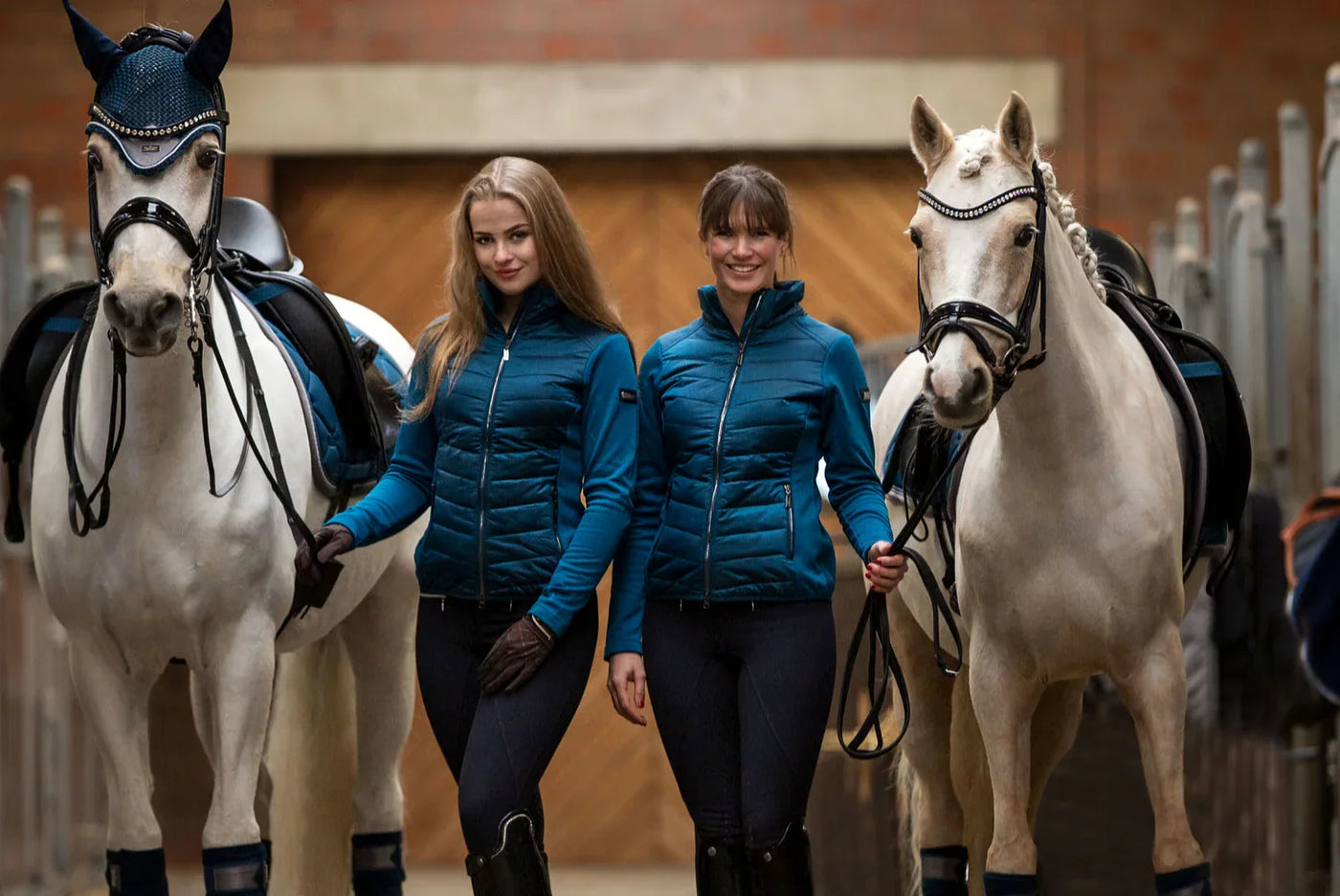
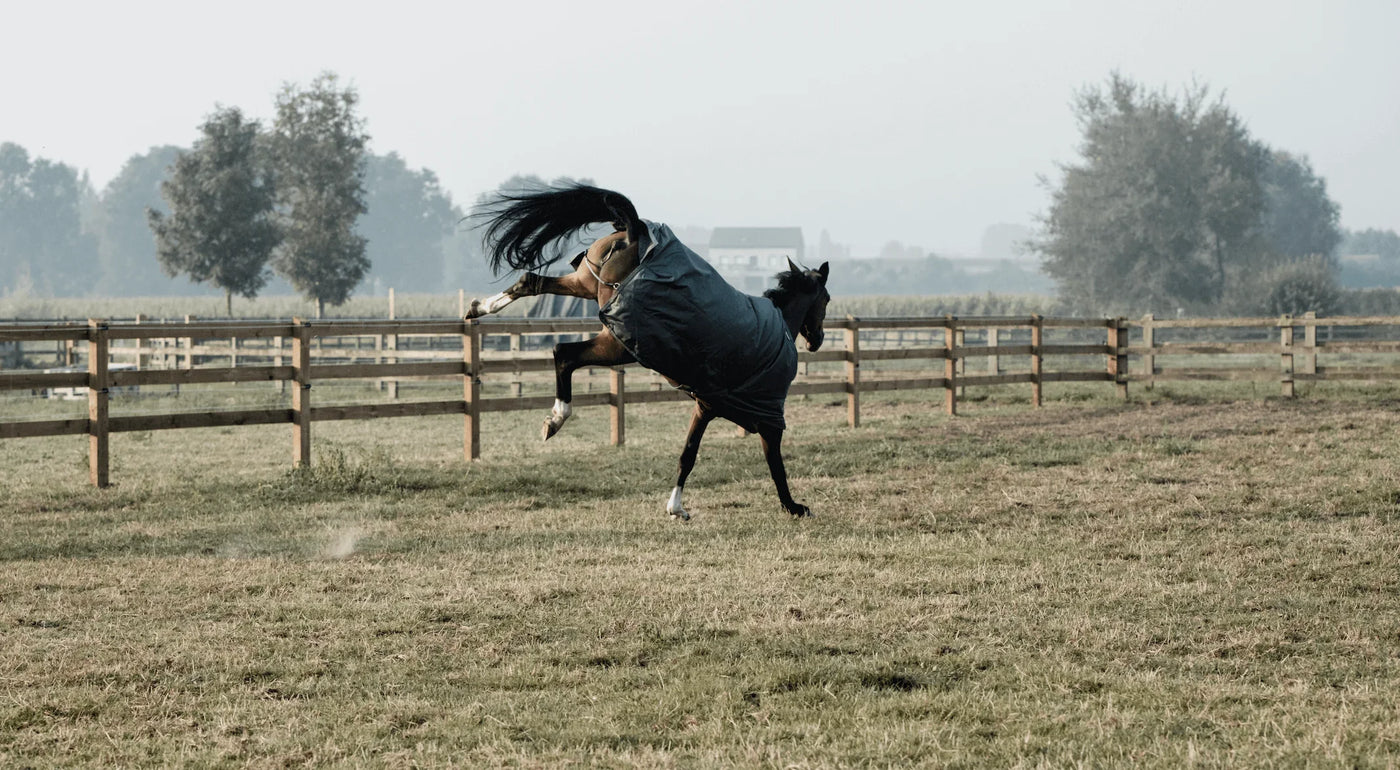
As soon as temperatures rise, the question returns, wandering through every stable aisle in May and June: "Which Fly Rug do I actually need – and isn’t one enough for everything?" The honest answer is: One single rug rarely covers all situations because a rug for riding is designed differently than a rug for the paddock, and a Sweet Itch horse has very different requirements than a sturdy warmblood that only uses the pasture for a few hours.
In this guide, we clear up confusion and show you, which Fly Rug really fits your daily routine. You will learn what distinguishes a riding rug from a fly riding rug, why a Sweet Itch Rug is not just "premium marketing," and how to determine the right Size – without ending up with a rug in the closet that you never use again.
1. Why a horse even needs a Fly Rug
Flies are not just annoying – they are a health problem. Horseflies suck blood and can transmit diseases, stable flies irritate eyes and nostrils, and the notorious Biting Midge (Culicoides) triggers summer itch in sensitive horses. Horses react to insect infestation with stress, increased tail swishing, restlessness in the pasture, and in the worst case, open rub sores.
A Fly Rug creates a physical barrier between horse and insect. It is often more effective than any spray – simply because it works 24/7, while a fly spray loses its effect after a few hours. If you want to learn more about the triggers and treatment of summer itch, you can find the background on the disease itself in our story "Summer, Sun, Sweet Itch Season – How can you help when it itches?" .
The 6 most important rug types compared
The classic Fly Rug (Pasture Rug)

The all-rounder for the daily horse on the p
rug or in the open stable. Fine mesh fabric, breathable, often with saddle cutout free, but with chest closure and tail cord. Models like the Fly Rug Complete Plus or the Fly Rug Protect are classics in this category.
For whom: Horses that spend several hours daily in the pasture. Important: Tear-resistant Material (Denier count from 600D) so the rug withstands rolling, nibbling, and nudging from stable neighbors.
The Fly Riding Rug (or "Riding Fly Rug")

A special type – not to be confused with the regular turnout rug. It has a saddle cutout and is worn with the saddle. This way, the horse stays protected during rides through woods, meadows, and fly hotspots, while you can ride as usual. Examples from our range: Buzz-Off Riding fly sheet or the Flexi Fly III turnout rug.
For whom: Riders who regularly ride through insect-rich areas in summer (forest paths, near rivers, evening rides).
Important: Pay attention to a low-set tail strap and a clean saddle cutout so nothing rubs.
The Sweet Itch Rug

The specialist for horses diagnosed with summer eczema. It differs from the normal Fly Rug by:
- Tighter mesh fabric that does not let even the tiny biting midge through
- Closed belly flap that completely covers the sensitive belly seam
- Integrated neck part (not removable), often reaching up to the nostrils
- Often double-layered in the mane and tail root area – where bites most often cause skin reactions
The Ekzemerdecke Sweet Itch is a typical example: a seamless protection system for horses where even a single mosquito bite can lead to weeks of treatment.
For whom: Horses with proven allergy to insect saliva. Important: These rugs are worn continuously for many weeks – the fit must be perfect, otherwise rub spots will develop exactly where the horse is sensitive.
The Paddock Fly Rug
A sturdier cut for horses that stand a lot on hard ground. Stronger Material, often with reflective elements and especially scratch-resistant – because paddock ground wears out rugs faster than grass. Models: Paddock Fly Rug Sunshine II, Paddock Fly Rug Superb.
For whom: Stabled horses with paddocks, active stable residents, horses with frequent changes of position.
The Transport Fly Rug

Light cut, often with Velcro instead of buckles – so you can quickly put the rug on and take it off your horse. Practical for competitions, summer vet visits, or simply to cover after Washing when the horse should dry in the sun for a few minutes. Example: Transport Fly Rug Stripe.
The training, lunging, and lunge system rug

Special designs for exercise sessions. A Longierdecke Fly fits differently than a turnout rug because it has to move with the horse in walk-trot-gallop without slipping. If you regularly exercise your horse on the lunge system , you should use a special lunge system rug Fly Comfort there – it is cut so that it cannot get caught in the stirrup of the machine.
Which rug for which situation? – The decision guide
| Situation | Recommendation | Why |
|---|---|---|
| Daily turnout, healthy horse | Classic Fly Rug | Robust, breathable, good value for money |
| Ride through forest & meadow | Fly riding rug | Saddle cutout, protects during riding |
| Summer Sweet Itch diagnosed | Sweet Itch Rug with belly flap & neck cover | Seamless all-around protection, tighter fabric |
| Paddock (sand/concrete) | Paddock Fly Rug | Reinforced Material against abrasion |
| Competition, transport, quick on/off | Transport Fly Rug | Lightweight, simple fastenings |
| Groundwork, lungeing | Lungeing/training rug Fly | Cut optimized for movement |
| Leading rein | Leading rein rug Fly | Safe, low risk of snagging |
Realistically considered many horse owners actually need two rugs: a turnout rug for everyday use and a fly riding rug for rides. Sweet Itch horses often need three – day, night, and one to change because the rug needs to be washed regularly.
Important features: neck cover, belly flap, zebra pattern & co.
Neck cover – yes or no?
A neck cover extends the protection area up to the mane and even to the ears. Mandatory for Sweet Itch horses, useful for sensitive horses, optional for robust characters. Look for detachable neck covers (e.g. Fly Rug Protect with detachable neck cover) – so you can vary depending on weather and temperature.
Belly flap
The belly flap is an additional fabric panel that runs under the belly and protects the sensitive belly seam. This is exactly where Sweet Itch horses often rub themselves raw. Models like the Fly Rug Comfort with Belly Flap or the Buzz-Off Belly Flap Zebra from Bucas are an investment that pays off here.
Zebra pattern – marketing or science?
Actual science: Studies (including from the University of Bristol, 2019) show that horseflies and gadflies land significantly less often on striped surfaces. The stripe effect confuses the insects' visual system during approach. Models like the Outdoor Fly Rug Comfort Flexi Zebra or the Fly Rug Zebra with Cross Straps take advantage of this effect – especially recommended for horses that suffer heavily from gadflies.
Fringes on the hem
The small fringes at the blanket’s edge (Fly Riding Sheet Protect with Fringes) are not just decoration: they move slightly while walking and chase away insects on the belly and hind legs. Especially useful for horses that spend a lot of time walking.
UV protection
Light-colored horses, greys, and horses with unpigmented nostrils get sunburned quickly. Blankets with UV protection factor (often labeled “Sun Protect”) significantly reduce the risk. The Paddock Fly Sheet Sunshine II is a proven option here.
Measuring size correctly – it’s that easy
A blanket that’s too short rubs on the shoulder. One that’s too long slips and can get caught. Here’s how to measure correctly:
- Stand your horse straight – not slouching, not stretched.
- Place the tape measure at the breastbone (center front).
- Lead over the shoulder, past the withers, parallel to the spine.
- Measure to the base of the tail .
The result is the back length. Most manufacturers specify their blankets in this measurement (e.g. 125 cm, 135 cm, 145 cm). If you’re between two sizes, choose the larger one – but only if the blanket is well adjustable at the front .
Tip: With Bucas and Horseware you often find English sizes (5'9", 6'0" etc.) – just convert the centimeters or use our size chart on every product.
Care & storage: So your blanket lasts for several seasons
- During the season brush off or rinse with a garden hose every 2–3 weeks
- Wash thoroughly between seasons – best in a blanket washing machine at the saddler’s, not in your home machine (the fabric is abrasive)
- Renew impregnation if the blanket soaks up water instead of repelling it after extended use
- Store dry in a breathable bag – not in plastic, otherwise mold will form
- Check fastenings and seams before first use in spring – mice love stable cupboards
FAQ – your most frequently asked questions
How long can a horse wear a Fly Rug continuously? With high-quality, breathable rugs, wearing during the day is no problem. But we recommend taking the rug off at least once a day, checking the coat, and preventing rubs. Eczema horses often wear their rug 24/7 – here a second rug for changing is a must.
Can my horse sweat in the Fly Rug? High-quality rugs are woven so tightly that they remain breathable. Still: on really hot days (over 30°C in direct sun), the horse should have shade – rug or no rug.
Can I leave the Fly Rug on in the rain? Only if it is a rain Fly Rug (e.g., Rain Fly Rug Protect) or the model is explicitly water-repellent. Normal mesh rugs get heavy in the rain and press on the shoulder.
My horse scratches despite the Fly Rug. What to do? Check three points: 1. Does the rug fit properly? No gaps? Belly flap present? 2. Is the fabric density sufficient? Eczema horses need tighter mesh. 3. Fly Mask included? The head is not covered by the rug – here a Fly Mask helps, ideally with nostril fringes.
Is a more expensive rug really worth it? Yes, in two cases: for eczema horses (health factor) and for paddock horses (wear factor). For a sturdy horse in the pasture, a solid mid-range rug does a good job.
Conclusion: There is no one right rug – but there is the right rug for your situation
Once you understand that a Fly Rug is not a one-size-fits-all product, but that different solutions exist for different situations, you make a much better purchase decision. When in doubt: better two specialized rugs (e.g., pasture + ride) than one that tries to do a bit of everything.
👉 Discover all Fly Rugs & Ekzem rugs in the kavalio shop
Not sure which rug is right for your horse? Feel free to write to us – our team rides themselves and knows the rugs from practical experience.