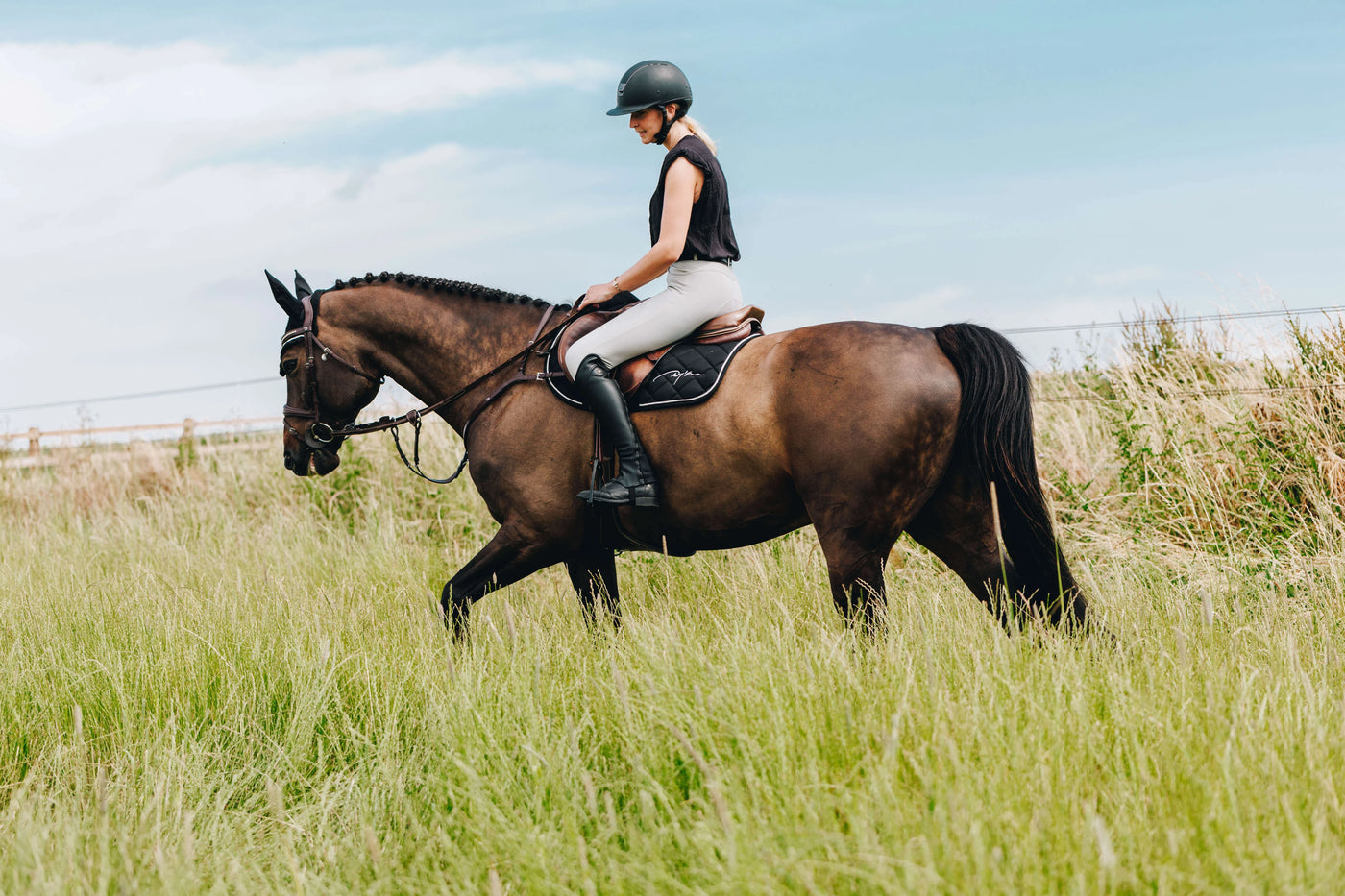
In our exercise today, it's all about consistency in the canter. A regular and harmonious rhythm in this gait is the foundation for all further tasks that you and your horse want to tackle together. Whether it’s approaching obstacles correctly or progressing to higher-level dressage movements, a solid basic canter forms the cornerstone.
By incorporating poles, you not only bring variety to your training routine but also simultaneously promote your horse’s relaxation through the rounding of the back. Additionally, the powerful push-off in the movement sequence is supported.
What do I need for these exercises?
The best part about this effective exercise is the simple setup that any rider can quickly arrange in their home indoor arena or riding arena.
With five ground poles, you have everything you need for your #KAVALIOCANTERCHALLENGE! We also recommend using pole blocks to minimize the risk of injury from stepping on the poles.
For our task, place three of the five poles along the center line. The distance between them should be about 14 meters; depending on whether your horse has a relatively large or particularly small canter stride, the spacing between the poles can vary. The distance between the middle pole and the diagonally placed obstacles should also be around 14 meters.
Let’s get started!
After you and your horse have warmed up sufficiently, you can begin the exercise. You can already incorporate the poles into your work at the trot, first overcoming selected poles individually, then several poles in sequence. It’s important that you approach the obstacles in the middle so you can work with the poles on both straight and curved lines. Check out our suggestions on how to loosen your horse over the poles at the trot:
Canter, march!
After you’ve already overcome the obstacles at the trot, it’s time for the canter work. At first, you can canter over the three poles on the center line in both left and right canter. The distance of 14 meters is usually covered with three canter strides between the poles.
Repeat the exercise several times until you find the right canter tempo to master this line smoothly. But it’s not just the right amount of canter that’s the focus of this exercise; maintaining a straight line before, between, and after the poles is also crucial!
And as if that weren’t #CHALLENGE enough, after the middle pole on the center line, you can also canter over either the diagonally placed poles to the right or to the left. Here, too, it’s important to maintain the prescribed three canter strides.
Can you do more?
Are these exercises easy for you and your partner? Then you can get creative and independently increase the difficulty! Design a course where you ride the given lines in different directions and combine the possibilities. Of course, you can also vary the number of canter strides between the poles by adjusting your canter. For example, try riding four instead of three canter strides! To raise the challenge even further, you can raise the obstacles as you like.
Here’s an example course we’ve put together for you:
What the pro says
We are incredibly proud to have professional riders like our dear Sarah Nagel-Tornau on board in our #KAVALIOFAMILY, and we place great value on her supporting us with her expertise on topics like these.
“I’m a big fan of rhythm exercises like these. With little effort, you can achieve a big effect for both rider and horse! I also like to include such tasks in training with my students because the right rhythm is the foundation for a successful course!”
Many thanks to @beroett for the wonderful photos!
Sarah’s insider tip
“If the arena or riding area dimensions allow, it’s a good idea to extend this exercise by measuring the distances between the obstacles for five or even more canter strides, as this allows you to better train changing the number of canter strides in the exercise. This exercise is also great for riders who have different horses or are just getting to know their training partner! As a rider, you get to know your horse’s canter and get an idea of how different distances should be approached with this horse in a course and whether your horse’s canter stride is rather large or relatively small. With a horse that naturally has a small canter, the rider should give supportive driving aids; with a horse that has a large canter, fine aids for collection should be given. This way, as a rider, I can help my horse maintain an even canter rhythm over various distances.” :-)
On your marks – get set – #KAVALIOCANTERCHALLENGE
Have our exercises made you curious? Then hop on your horse and dive into the pole forest! Let yourself be advised during this training session by an experienced rider or your trainer.
Train your consistent rhythm in the canter and tag us in your #KAVALIOCANTERCHALLENGE story on Instagram :-)